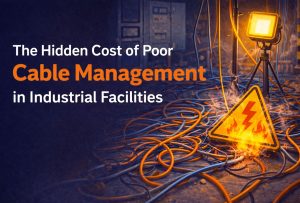

In industrial environments, cables are often treated as background infrastructure—installed once and largely overlooked. However, this approach can lead to serious operational and safety challenges over time.
Poor cable management is not just an aesthetic issue. It directly affects performance, reliability, and long-term costs. From manufacturing plants to commercial buildings and data-driven facilities, unstructured cabling systems can create inefficiencies that gradually turn into major problems.
This blog explores the hidden costs associated with poor cable management and highlights why businesses must prioritize structured and well-planned cabling systems.
Increased Risk of Electrical Hazards
Improper cable routing, overloading, and tangled wiring significantly increase the likelihood of electrical hazards. When cables are poorly organized or lack proper insulation, they become vulnerable to environmental factors such as friction, dust, moisture, and mechanical stress.
Over time, these conditions can lead to short circuits, overheating, and even fire hazards. In high-load industrial environments, even a minor fault can escalate quickly, posing serious risks to both infrastructure and human safety. Effective cable management plays a crucial role in minimizing these risks and ensuring a safer working environment.
Higher Maintenance and Downtime Costs
Disorganized cabling systems make troubleshooting far more complicated than it needs to be. When cables are not clearly arranged or labeled, identifying the source of a fault takes significantly longer. Repairs become more complex, and operational downtime increases.
In industries where operations run continuously, even a short interruption can result in substantial financial losses. A structured cable layout, on the other hand, allows maintenance teams to quickly locate and resolve issues, reducing downtime and improving overall efficiency.
Reduced Cable Lifespan
Cables that are bent excessively, exposed to heat or chemicals, or improperly bundled tend to degrade much faster than expected. Continuous stress on cables weakens insulation and affects the integrity of conductors, ultimately leading to premature failure.
This not only increases replacement frequency but also raises procurement and labor costs. Proper cable management helps protect cables from external damage and ensures they perform reliably over a longer period, reducing the need for frequent interventions.
Inefficient Energy Transmission
The way cables are arranged and routed has a direct impact on energy efficiency. Poor cable layouts can result in voltage drops, increased resistance, and unnecessary energy loss. When cables are overloaded or not optimized for their intended use, the overall performance of the system declines.
This inefficiency not only increases energy consumption but also affects the functioning of connected equipment. Well-managed cabling ensures better load distribution, improved efficiency, and long-term cost savings.
Compliance and Safety Concerns
Industrial facilities are required to meet strict safety and regulatory standards. Proper cable management is a critical part of maintaining compliance with fire safety norms, workplace safety guidelines, and infrastructure audits.
Failure to meet these standards can result in penalties, insurance complications, and even operational restrictions. More importantly, it reflects poorly on an organization’s commitment to safety and professionalism. Organized cabling is therefore not just a best practice but a necessity.
Challenges in Scalability and Expansion
As businesses grow, their infrastructure must adapt. Poor cable management can create significant obstacles when it comes to expansion or system upgrades. Adding new equipment or modifying existing layouts becomes time-consuming and expensive when the underlying cabling system is unstructured.
A well-planned cable infrastructure allows for seamless scalability, enabling businesses to expand without disrupting ongoing operations.
Impact on Workplace Efficiency
Beyond technical and financial concerns, poor cable management can also affect overall workplace efficiency. Cluttered cabling can create confusion, increase the risk of accidental damage, and make it difficult for teams to operate effectively.
In contrast, a clean and organized system contributes to a safer, more efficient, and professional working environment.
Best Practices for Effective Cable Management
To avoid these challenges, industries must adopt a proactive approach to cable management. This includes planning structured routing systems, ensuring proper labeling and documentation, using high-quality insulated cables, and installing appropriate support systems such as trays and conduits. Regular inspection and preventive maintenance also play a key role in maintaining system performance.
Conclusion
Cable management may often be overlooked, but its impact on industrial operations is significant. What may seem like a minor detail can lead to safety risks, financial losses, and operational inefficiencies if ignored.
On the other hand, a well-managed cabling system enhances safety, improves performance, and supports long-term growth. Investing in quality cables and proper management practices is not just a technical decision—it is a strategic step toward building resilient and future-ready infrastructure.
Closing Note
At Servel India, we understand that reliable infrastructure begins with strong foundations. Our cable solutions are designed to deliver safety, durability, and consistent performance—supporting industries that demand excellence.