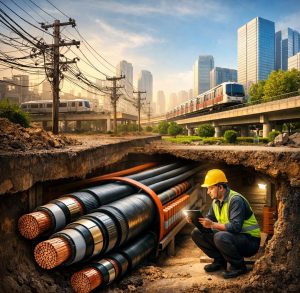

The demand for high-quality electrical cables in India is rising rapidly due to increased government infrastructure spending, renewable energy expansion, and urban development projects.
Today’s infrastructure goals are not just about construction they are about creating safe, efficient, and future-ready electrical networks that support decades of growth.
📊 India’s Infrastructure Growth — By the Numbers
🏙 Smart Cities & Urban Development
• The Smart Cities Mission aims to develop 100 smart cities in India.
• Expected cumulative investment: ₹2 trillion+ (USD ~25B) by 2025.
• These cities rely on reliable power, data connectivity, automation, and safety — all powered by robust cabling systems.
🚇 Metro & Rail Electrification
• Moreover, India is rapidly expanding metro rail networks across tier-1 and tier-2 cities.
• By 2030, India is expected to have 1,000+ km of metro rail lines launched or under construction.
• Electrified rail systems require high-current power cables and signalling cables with high safety standards.
⚡ Renewable Energy Transmission Expansion
India’s renewable energy capacity targets are among the most aggressive in the world:
• Renewable energy capacity expected to surpass 220 GW by 2026 (Central Electricity Authority).
• Solar power alone is projected to reach ~150 GW by 2026 and ~280 GW by 2030.
• Transmission systems connecting solar farms require specialized cables with low transmission loss and high temperature tolerance.
👉 Roughly every 1 GW of solar capacity adds a significant requirement for high-performance DC/AC cables in grid connections.
🚗 Electric Vehicles — A Fast-Growing Sector
As a result, EV adoption in India is accelerating due to policy support and incentives:
• EV sales projected to grow at a 30–40% CAGR through 2030 (Frost & Sullivan).
• By 2030, India could have 10–15 million EVs on the road.
• EV charging infrastructure targets call for 100,000+ public charging stations by 2030.
EV chargers operate at high voltages (400–800 V) and high currents (200–500 A). This means:
✔ Cables must be heat resistant
✔ Cable insulation must handle repeated thermal cycling
✔ Long-term reliability is essential
These requirements directly increase demand for premium electrical cables with robust construction and safety characteristics.
🏭 Industrial Growth & Power Demand
Manufacturing and automation are on the rise:
• The Indian manufacturing sector aims to contribute 25% of GDP by 2030.
• Industrial electricity demand could grow at ~6–7% CAGR through 2030 (IEA/CEA estimates).
• Industrial automation and robotics require stable, interference-free cabling.
This means industries need more than just standard power cables — they require:
• Control and instrumentation cables
• Shielded and armored cables
• High-performance multi-core solutions
🔍 Why Cable Quality Matters
Two cables can have the same cross-sectional size and rating yet perform very differently depending on:
Conductor design & compaction
Affects heat dissipation and current carrying capacity
Insulation type
Dictates temperature tolerances and safety
Mechanical protection
Improves resistance to abrasion and environmental stress
Manufacturing consistency
Reduces defects and early failures
In real installations, cable failures can cause:
❌ System downtime
❌ Fire hazards
❌ Increased maintenance costs
❌ Energy losses of 5–10% or more
In high-power or continuous-use systems, even a small efficiency improvement (1–2%) translates to huge energy savings over time.
📌 Choosing Quality Over Price
While budget constraints often influence purchasing decisions, choosing lower-grade cables can result in:
📉 Higher overall lifetime cost
📉 Shorter service life
📉 Frequent replacements
📉 Increased safety risk
In contrast, premium cables built with strong engineering practices provide:
✔ Consistent performance
✔ Lower energy loss
✔ Better safety margins
✔ Longer lifecycle peace of mind
🧠 What This Means for the Cable Industry
As government spending in infrastructure, power networks, and EV systems increases, demand for quality cables is skyrocketing:
• A conservative market estimate expects India’s cable market to grow at ~7–9% CAGR through 2030.
• The power cable segment alone could exceed ₹50,000+ crore (USD ~6–7B) by 2030.
This makes cable manufacturers with a focus on quality and performance strategic partners for tomorrow’s infrastructure.
🏁 Conclusion
India’s progress story is not only about steel and concrete it’s about the electrical networks behind every modern system. Smart cities, EV mobility, renewable energy, and industrial automation all depend on safe, reliable, high-performance cables.
And as infrastructure spending grows, so does the demand for engineers, designers, and manufacturers who can deliver on performance, safety, and longevity.
According to the Ministry of Power, India’s electricity demand is expected to grow significantly over the next decade. https://powermin.gov.in
As discussed in our blog on smart infrastructure in India, the demand for reliable and high-performance electrical cables is directly linked to the nation’s modernization efforts. https://servelindia.com/smart-infrastructure-in-india-quality-cables/