
India is undergoing one of the most significant infrastructure transformations in its history.
From AI-driven industries and hyperscale data centers to renewable energy parks and electric vehicle charging corridors, the country’s power demand profile is changing rapidly. What was once a predictable load pattern is now becoming dynamic, high-density, and performance-intensive.
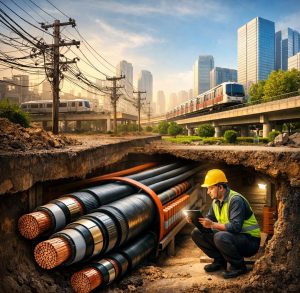
At the center of this transformation lies a critical yet often underestimated component — high-performance electrical cables.
As India accelerates toward a digitally empowered and energy-secure future, advanced cable systems are no longer optional. They are foundational.
India’s Digital Expansion: The Rise of AI & Hyperscale Data Centers
India is witnessing massive investments in:
• Artificial Intelligence (AI) infrastructure
• Cloud computing and SaaS platforms
• Fintech ecosystems
• 5G telecom networks
• Edge computing facilities
• Government-backed digital initiatives
Data centers are expanding across Mumbai, Chennai, Hyderabad, Noida, and emerging Tier-2 cities. These facilities operate 24/7 and consume enormous amounts of power.
Unlike traditional commercial buildings, AI and hyperscale data centers:
• Operate at high power densities
• Generate significant heat loads
• Require uninterrupted power supply
• Demand precision in voltage stability
Even milliseconds of power disruption can cause operational setbacks, financial losses, or data integrity risks.
This makes power infrastructure quality non-negotiable.
The Energy Transition: Renewables & Grid Modernization
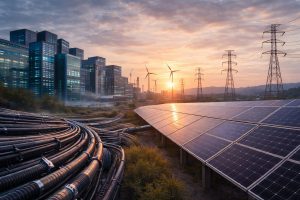
India’s renewable energy capacity is growing aggressively. Solar parks, wind farms, and hybrid energy systems are being integrated into the grid at unprecedented scale.
However, renewable energy introduces variability into power systems.
This means cable infrastructure must now handle:
• Fluctuating load patterns
• Higher current variations
• Long-distance transmission
• Grid modernization upgrades
Advanced cables with superior insulation, thermal resistance, and mechanical durability are essential to maintain performance under these evolving conditions.
Why Standard Cables Are No Longer Sufficient
Older-generation cable systems were designed for moderate load conditions and predictable environments.
Today’s infrastructure demands:
- Higher Load Capacity
AI facilities, EV charging hubs, and industrial automation require cables capable of carrying increased current without overheating.
- Enhanced Thermal Performance
Modern installations often operate in high-temperature environments. Cables must resist heat degradation while maintaining insulation integrity.
- Fire Safety & Compliance
With stricter safety norms in commercial and industrial spaces, fire-retardant and low-smoke cables are becoming mandatory in many applications.
- Energy Efficiency
Lower transmission losses translate directly into operational savings — especially in power-intensive sectors.
- Long Operational Lifespan
Infrastructure investments are long-term commitments. Cable systems must deliver durability and minimal maintenance.
In short, cable systems today must support not just power transmission — but infrastructure resilience.
EV Infrastructure: A High-Load Revolution
India’s electric mobility push is creating a new category of energy demand.
Fast-charging stations require:
• High current capacity
• Robust insulation systems
• Stable voltage handling
• Heat-resistant performance
As EV corridors expand along highways and urban centers, cable infrastructure must withstand continuous high-load operations.
Poor cable quality in such applications can lead to:
• Voltage drops
• Thermal stress
• Increased maintenance costs
• Safety risks
The growth of EV infrastructure is redefining expectations from electrical systems.
Industrial Automation & Smart Manufacturing
The “Make in India” and Industry 4.0 movements are accelerating automation in manufacturing.
Smart factories rely on:
• Precision power supply
• Continuous operations
• Reduced downtime
• Integrated control systems
Industrial cables must now meet higher standards of performance, shielding, and durability.
Any failure in power transmission can disrupt entire production cycles.
The Shift Toward High-Performance Cabling
India’s infrastructure future requires cables that offer:
• Advanced insulation materials
• Heat resistance under continuous load
• Mechanical strength
• Compliance with evolving safety standards
• Reduced transmission losses
• Stable long-term performance
High-performance cables are no longer just a premium option — they are a necessity in high-growth sectors.
The Bigger Picture: Infrastructure Resilience
India’s economic growth trajectory is closely tied to infrastructure stability.
Whether it is:
• AI data centers
• Renewable power integration
• Smart cities
• Metro rail expansion
• Industrial automation
• EV charging ecosystems
Each of these sectors depends heavily on dependable electrical systems.
And dependable electrical systems begin with quality cabling.
Conclusion: Powering India’s Next Growth Phase
India is not just building more infrastructure — it is building smarter, faster, and more energy-intensive systems.
As demand grows and technology advances, the role of advanced electrical cables becomes increasingly critical.
The future of India’s digital and industrial growth will depend on:
• Performance
• Reliability
• Safety
• Efficiency
Behind every intelligent system, renewable grid, EV charger, and data center lies a robust power backbone.
The transformation is visible on the surface but its strength is built from the core.
According to the Ministry of Power, India’s electricity demand is expected to grow significantly over the coming years due to digital infrastructure and industrial expansion. https://powermin.gov.in/